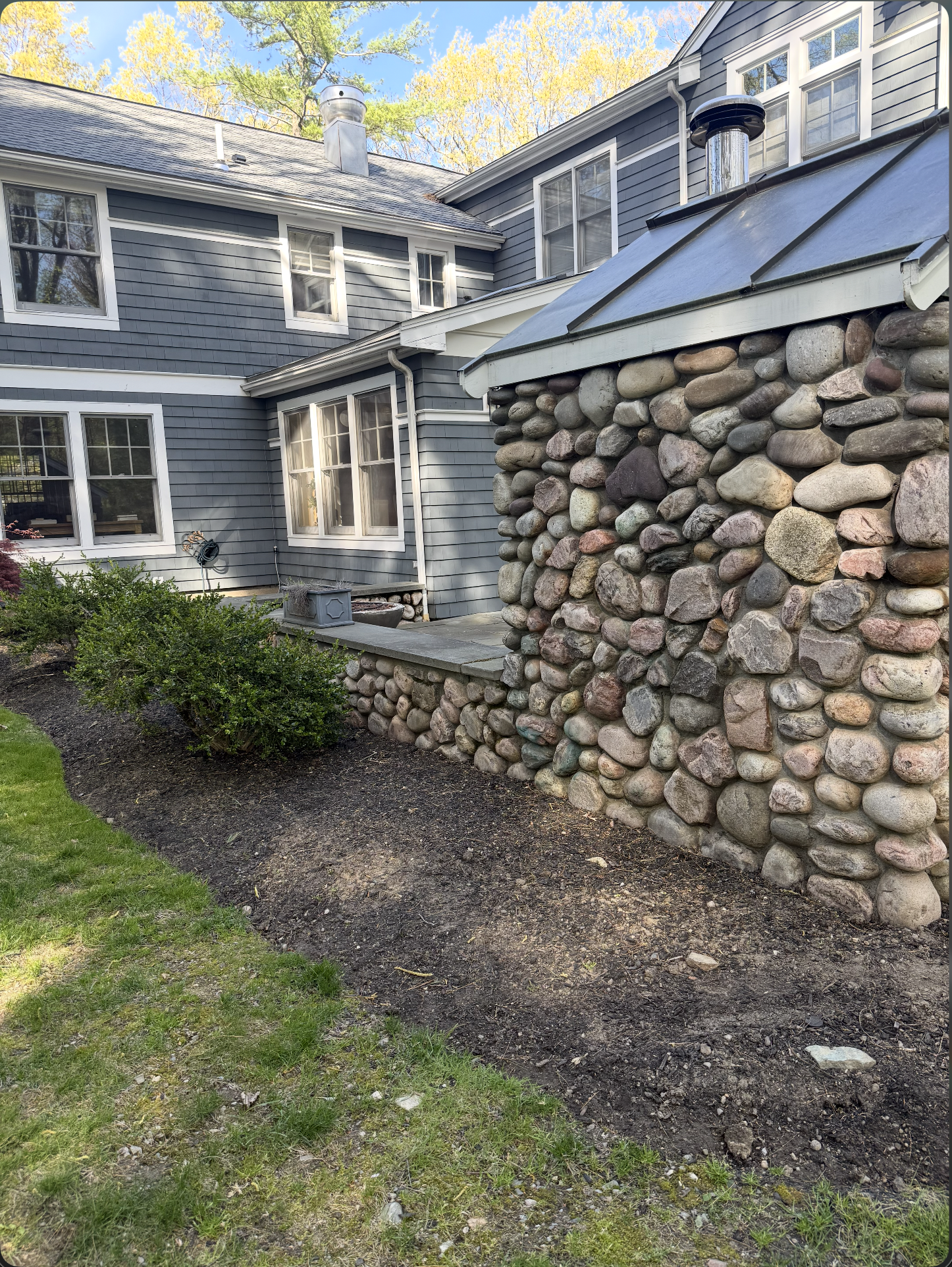
Every spring, the same scene plays out in Massachusetts backyards. The first warm Saturday hits, homeowners walk out to their beds with a fresh bag of mulch from Home Depot, and they spread it before lunch. The yard looks great for two weeks. Then the perennials come up late, the weeds break through anyway, and they wonder what went wrong.
The answer is timing. Mulching in Massachusetts is one of those tasks where doing it at the wrong moment is almost as bad as not doing it. Too early traps cold in the soil and slows your perennials by two to three weeks. Too late lets weeds get established first, which means the mulch suppresses very little and you spend the rest of the summer pulling stuff that shouldn't be there.
This guide covers the right window for mulching across Massachusetts, the soil-temperature rule professional crews use, the small adjustments that matter by town (a Brookline yard mulches a few days earlier than a Wayland yard), and what to do if you missed the spring window entirely. By the end you'll know exactly when to mulch your Massachusetts yard in 2026 and beyond.
Key Takeaway
The right window to mulch a Massachusetts yard is late April through mid-May, once soil temperature reliably hits 55°F. Mulching earlier traps cold in the soil and delays growth. Mulching later lets weeds get established before the mulch can suppress them.
The Right Window: Late April to Mid-May
The headline rule is simple: mulch your Massachusetts yard from late April through mid-May. Specifically, the sweet spot for most of the Boston metro area and Metro West is between April 24 and May 15. That window gives you all of the timing benefits and none of the costs.
Why that exact range? Three things converge in late April for most MA yards: the soil has warmed enough to support active root growth, the first wave of spring weeds is just emerging (so mulch can suppress them before they take hold), and the heaviest leaf and debris cleanup is finished. By mid-May, perennials have broken dormancy and you can see exactly where they're coming up, which prevents the most common mulching mistake: burying new growth.
The Soil Temperature Rule Professional Crews Use
If you only remember one number from this guide, remember 55. That's the soil temperature, in Fahrenheit, that signals "go" for mulching in Massachusetts. Below 55, the soil is still too cold and mulch will act as insulation that holds the cold in. Above 55 and you're in the right zone.
You don't need a soil thermometer (though they cost five dollars and they're useful for vegetable gardens too). A practical homeowner test: kneel down and put your bare hand flat on the soil in a sunny bed for thirty seconds. If it feels cool but not cold, soil is at or above 55. If it feels meaningfully cold, give it another week.
Most MA towns hit 55-degree soil by April 22 to April 30 in a typical year. A warm April can shift that earlier by 7 to 10 days. A cool, wet April can push it later by 7 to 10 days. The window of "right time" is wider than people think, but it has a clear floor.
Why Not March or Early April?
Massachusetts homeowners are tempted by the first warm Saturday in mid-March every year. Don't do it. Mulching in March or early April creates three real problems:
- Cold lock. Mulch is an insulator. Spread on cold soil, it holds the cold in. Your perennials come up two to three weeks later than they should, and your bulbs sometimes fail to push through entirely.
- Wet soil compaction. Massachusetts soil is usually saturated in March. Walking on wet beds with wheelbarrows of mulch compacts the soil and damages the soil structure your plants depend on.
- Mulch washout. Spring rains in late March and early April are heavy and frequent. Fresh mulch on cold, wet soil tends to wash, mat, and shift around. By the time things stabilize, your beds look messy and uneven.
If you absolutely must mulch early because you're listing your house for a March open house, do a light "appearance refresh" with one inch of mulch on the most visible front beds, and plan a real full mulching after the listing closes. Don't lay down a real 3-inch layer in March anywhere you want plants to thrive.
Get a free, itemized mulching quote for your MA yard
We measure your beds, calculate yardage in front of you, and send a written quote within 24 hours. Fully insured. Local crews. Honest pricing.
Request Your Free Quote →What If You Missed the Spring Window?
You didn't miss the year. You just missed the easy mode. Mulching in June, July, or even early August is completely fine for Massachusetts yards. The differences are practical, not biological.
Late spring (late May to mid June): Still excellent. Weeds will be more established, so a thorough hand-weeding pass needs to happen before mulch goes down. Otherwise the mulch suppresses very little. The work is harder, but the outcome is identical.
Early summer (mid June to mid July): Solid choice. Demand has dropped from spring peak so professional crews often have better availability and slightly lower pricing. Soil is warm, plants are visible, perfect conditions for clean installation.
Late summer (late July to mid August): Possible but requires extra watering. Mulch helps with moisture retention, but newly mulched beds in August still need supplemental water for two to three weeks if there's a dry spell. Best paired with a half-inch top-off rather than a full 3-inch application if the previous mulch is still partially intact.
Should You Mulch in Fall in Massachusetts?
Yes, and it's underrated. Many MA homeowners mulch only once a year in spring and skip fall. But a light fall mulch (1.5 to 2 inches) does three useful things:
- Insulates perennial roots through deep winter freezes, especially valuable for marginal hardiness plants like certain hydrangeas and butterfly bushes in zones 5b and 6a.
- Suppresses the first wave of spring weeds that would otherwise get a head start in March and early April.
- Keeps your beds looking finished and intentional through fall and winter when nothing else in the yard is doing visual work.
The right window for fall mulching in Massachusetts is October through early November, ideally before the first hard frost and definitely before the ground freezes. A light fall mulch plus a proper spring mulch is the gold-standard maintenance pattern for higher-end MA properties.
Town-by-Town Microclimate Adjustments
Massachusetts isn't a single climate zone. The same calendar week can mean very different soil conditions across towns. Here's how the regional differences shake out for mulching:
Coastal-influenced (Brookline, Watertown, Belmont): Soil warms earliest because of urban heat retention and slightly milder coastal air. Typically ready by April 22 to 25. Mulching can start a few days earlier than inland towns.
Inland Metro West (Newton, Wellesley, Natick, Needham, Wayland): The middle of the curve. Typically ready by April 26 to May 1. This is the largest set of DEMBEX clients and it's where the "late April to mid May" rule applies most cleanly.
Northern/elevation-influenced (Lexington, Arlington, Concord): Soil warms last, especially in shaded backyards and lots with significant tree canopy. Typically ready by May 1 to May 6. Mulching a few days later is the right call.
Westernmost suburbs (Wayland, Sudbury, Sherborn): Variable. Open meadow-style lots warm fast, heavily wooded properties warm slow. Use the 55-degree soil test rather than the calendar.
Right Depth Matters As Much As Right Timing
The right amount of mulch is two to three inches for residential Massachusetts beds. This is the depth that gives you all the benefits (weed suppression, moisture retention, temperature moderation, soil enrichment over time) without the costs of overdoing it.
Common mistakes:
- "Mulch volcanoes" around tree trunks. A thick mulch pile against the trunk traps moisture against bark and invites disease and rot. Mulch should be pulled back 2 to 3 inches from tree trunks and shrub bases.
- Going too deep. Anything over 3 inches creates a water-shedding crust on top and can smother the shallow-rooted plants underneath. More is not better.
- Going too thin. Under 1.5 inches doesn't suppress weeds or hold moisture meaningfully. You'll re-mulch sooner and you won't see the benefits.
What Kind of Mulch to Use in Massachusetts
Most Massachusetts yards do best with shredded hardwood mulch. It's locally sourced, ages naturally to a warm brown, breaks down at the right rate to enrich soil over a season, and works for both ornamental beds and around foundation plantings. Pine bark is a close second and slightly better for acid-loving plants like azaleas and rhododendrons.
Dyed mulches (black, dark brown, red) cost more, look richer for the first 6 to 8 weeks, and then fade. They're a fine choice if curb appeal matters more than long-term soil health, and many staging-for-sale properties use them. For most everyday MA homes, natural is the better long-term value.
Avoid: rubber mulch (looks artificial and doesn't enrich soil), dyed black mulch in areas where it might track onto light hardscape (it stains), and bagged "decorative" mulch from big-box stores in volumes over 2 cubic yards (you'll save 30 to 40 percent buying from a landscape supplier in bulk).
If You're Booking a Crew, Bundle These Services
Professional mulching is rarely a standalone service. Most MA homeowners pair it with two or three related tasks:
- Spring cleanup 2–3 weeks before mulching. Clean beds get clean mulch. See our guide to spring cleanup timing in Newton for the full picture.
- Bed weeding immediately before mulch. Especially if your beds haven't been touched in a while. Our weeding service handles this.
- Light pruning of shrubs and perennials before mulch. Pruning after mulching disturbs the new layer. Do it in order. Pruning details here.
- If you're shopping for a quote in Natick specifically, our Natick mulching cost guide breaks down exactly what to budget.
Massachusetts Towns We Serve
DEMBEX provides professional mulching and full-service yard care throughout Greater Boston and Metro West Massachusetts. We regularly work in:
- Newton (all neighborhoods)
- Brookline
- Wellesley
- Needham
- Natick
- Wayland
- Lexington
- Arlington
- Belmont
- Watertown
- Waltham
- Dover
If you're nearby and not sure whether we cover your neighborhood, drop us a note. We probably do.
Final Thoughts: Wait for the Soil, Not the Calendar
The single best habit a Massachusetts homeowner can build around mulching is to watch the soil, not the weather. A warm March doesn't mean the soil is ready. A cool April doesn't mean you have to wait until June. Use the 55-degree rule, give yourself a window from late April to mid May, and you'll get the full benefit of mulching without any of the costs of bad timing.
When you're ready, request a free quote from DEMBEX. We'll walk your property, measure your beds, recommend the right mulch type for your soil and plants, and lock in a date in the right window for your specific town. Fully insured, clear communication, and a crew that treats your yard like it matters. Or learn more about our full mulching service.
Frequently Asked Questions
For most Massachusetts yards, the right mulching window is from late April through mid-May. The soil should be at least 55°F and the ground should no longer feel cold to the touch. Mulching too early traps cold in the soil and slows perennial growth. Mulching too late lets weeds get established first.
Generally no. Massachusetts soil is still too cold and often too wet in March and early April. Mulching too early acts like an insulator, keeping the soil cold and delaying perennial growth by 2 to 3 weeks. Wait until soil temperature consistently hits 55°F, which usually happens in late April for most Boston-area towns.
Not at all. June and early July are completely valid mulching windows for Massachusetts yards. You'll just want to weed thoroughly first since weeds will have established by then. Late summer mulching also has the benefit of cooler crew availability and often slightly lower pricing.
Yes, fall mulching is a smart move for many Massachusetts yards. A light fall mulch layer (1.5 to 2 inches) protects perennial roots through winter, suppresses early spring weeds, and gives beds a clean look for the season. The best window is October through early November, before the ground freezes.
2 to 3 inches is the sweet spot for Massachusetts residential beds. Thinner than 2 inches and you won't get weed suppression or moisture retention. Thicker than 3 inches and you risk smothering shallow plant roots and creating a water-shedding crust that hurts soil health.
The benefits of mulching are universal across MA, but timing varies slightly by town microclimate. Coastal-leaning towns like Brookline warm a few days earlier than inland towns like Wayland and Lexington. Northern towns like Arlington and Belmont tend to thaw last. Most professional crews work within a 7 to 10 day adjusted window depending on the town.